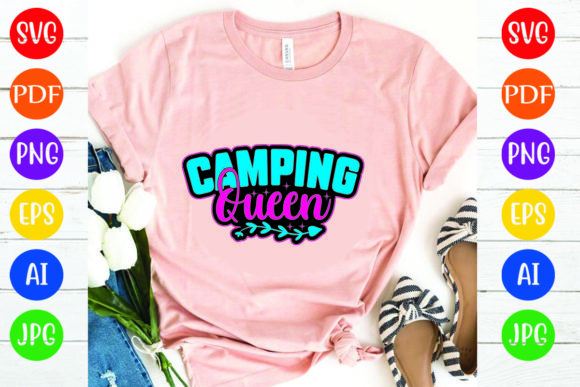
Camping Queen
First Impressions: Whimsy with Wearable Weight
When I opened the Camping Queen design, I didn’t see just another nature-themed graphic—I saw a mood. It’s playful but grounded, feminine without being fussy, and outdoorsy without leaning into cliché pine trees or cartoonish bears. The composition feels intentional: balanced negative space, clear silhouette flow, and a subtle hierarchy between the central phrase and supporting elements (like tiny tents or stars—though exact motifs depend on the version you receive). As an embroidery designer who’s stitched hundreds of text-based graphics, I immediately asked: Will this hold up at 3.5 inches wide on a sweatshirt cuff? Will the curves read cleanly in satin stitch? Does it invite personalization—or does it demand to stay exactly as-is?
A Real-World Test: Embroidering It on a Linen-Cotton Tote
Last week, I prepped Camping Queen for a custom order—a medium-weight linen-cotton tote for a boutique that sells handmade outdoor gear. Not sublimation. Not print. Real thread, real needle, real hoop pressure. I chose a matte cotton stabilizer and tested three thread palettes: forest green + cream, charcoal + oat, and rust + slate. The design scaled cleanly down to 4.25 inches wide—no distortion in the letterforms, no crowding in the “g” or “Q” curves. That told me the vector foundation (AI/EPS/SVG) is clean, not traced or over-optimized. The spacing between letters gave breathing room for fill stitch without bleeding, and the overall stitch density felt moderate—not so light it’d look washed out on textured fabric, not so dense it’d stiffen the tote’s drape.
Where It Shines—and Where It Asks for Care
- Custom apparel & sweatshirt embroidery: Works beautifully on midweight fleece and cotton-blend hoodies—especially centered on the chest or left-chest placement. The design’s width-to-height ratio avoids awkward stretching across seams.
- Tote bag design & aprons: Holds clarity even on loosely woven natural fibers, as long as you use tear-away + cut-away combo stabilizer. Avoid ultra-thin canvas unless you reduce density manually.
- Baby embroidery & nursery decor: Soft enough for onesies and pillow covers—but skip the smallest hoop sizes (under 3 inches) unless you’re confident your machine handles fine satin edges. Tiny decorative accents (if present) may vanish at sub-2.5" scale.
- Embroidered patch & cap embroidery: Proceed with caution on curved surfaces like structured caps. Test stitch the top arc first—the “C” and “n” could distort if hooped too tightly. Also verify whether the design includes underlay; if not, add light running stitch underlay to prevent puckering.
- Holiday embroidery & personalized gifts: A natural fit for summer solstice bundles, camping-themed baby showers, or anniversary picnic kits. Its tone reads warm and inclusive—not overly gendered, not childish—so it crosses age groups well.
What It Does for Your Craft Business
As an Etsy seller and small shop product developer, I judge designs not just by prettiness—but by how they affect perceived value, trust, and repeat appeal. Camping Queen lands firmly in the “elevates the ordinary” category. Stitched cleanly on a heavyweight tea towel? It reads boutique, not big-box. Applied to a reversible patch for denim jackets? It signals thoughtful curation. And because the file set includes transparent PNG and PDF, it doubles as a printable mockup asset—meaning you can show customers realistic previews *before* stitching, reducing returns and boosting confidence in your craft business.
That said, it’s not a one-size-fits-all workhorse. On dark fabric, avoid light-colored thread unless you’ve tested opacity—some fill areas may need a second pass or denser underlay. On stretchy knits (like lightweight t-shirts), skip direct-hooping; use adhesive + topping, and consider simplifying any fine interior details manually. And if you plan layered embroidery—say, adding a small embroidered tent beside the main design—check spacing in the original layout first. Overcrowding kills handmade presentation.
Practical Notes Every Embroidery Designer Should Run Through
- Test on scrap fabric first—especially if using textured, napped, or recycled-content fabrics. Linen blends behave differently than combed cotton.
- Check thread color contrast in natural light *and* on camera. What looks rich on screen may mute on oat-colored toweling.
- Review stitch density before sending to machine. If the design feels heavy in key zones (like thick letter strokes), reduce density by 5–8% for breathable wearables.
- Confirm hoop size compatibility. While Camping Queen scales well, very narrow hoops (like 3"x3") may require repositioning or trimming non-essential outer elements.
- Inspect small details at 200% zoom in your embroidery software. Are inner corners sharp? Do “i” dots anchor cleanly? If not, adjust pull compensation or add micro-trims.
- Test black-and-white mockups to assess silhouette strength—this reveals whether the design holds identity without color crutches.
- Compare light vs. dark fabric backgrounds using your actual thread palette. Some gradients or shadows in the original SVG may not translate to stitch.
- Use proper stabilizer: cut-away for knits, tear-away for stable wovens, and fusible + topping for nap or pile.
- Verify licensing terms before selling finished products or bundling the digital embroidery file. This is a T-Shirt Design and Graphics asset—confirm whether commercial embroidery rights are included.
Final Thought: A Design That Serves the Maker First
Camping Queen doesn’t shout. It invites. It fits neatly into a growing niche—thoughtful outdoor living, slow adventure, quiet joy in simple rituals—and translates just as well to a baby’s organic cotton bib as it does to a founder’s limited-run apron line. It’s not flashy, but it’s reliable. Not minimalist, but never cluttered. As a machine embroidery design, it respects the limits of thread and fabric—and as a digital embroidery file, it gives you room to adapt without losing its voice. For crafters, Etsy sellers, and small shop owners building recognizable, human-scaled brands? That kind of consistency isn’t just practical—it’s professional. And that’s why I’ll keep Camping Queen in my active rotation.